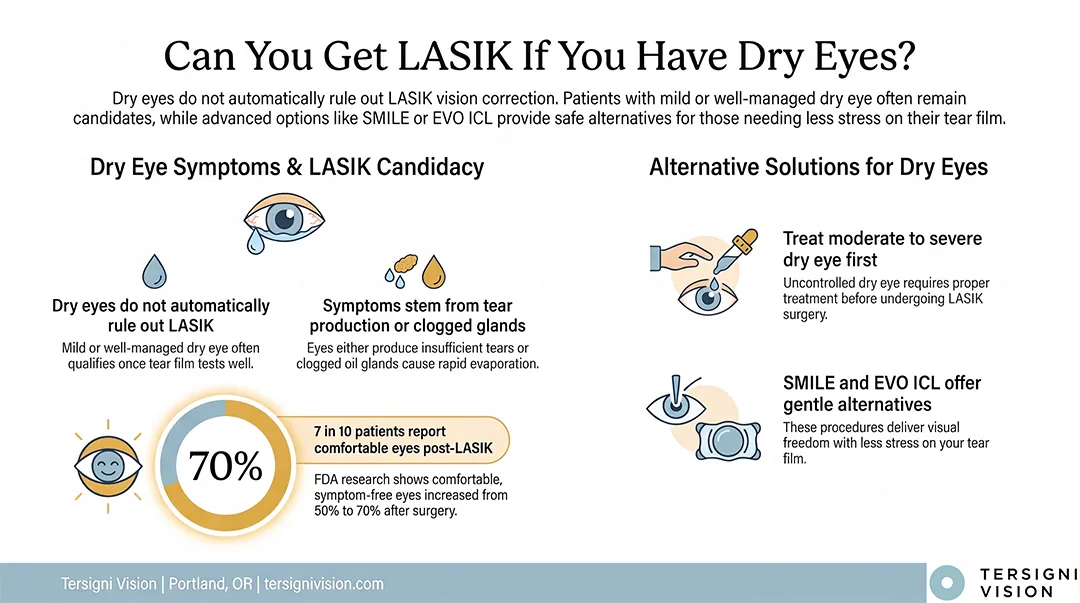
If your contacts feel like sandpaper by 3 p.m. and your eyes burn through the last hours of the workday, LASIK probably sounds like a dream. Then someone tells you dry eye rules it out. Dry eyes don’t automatically rule out LASIK. Mild or well-treated dry eye often still qualifies, and when it doesn’t, SMILE or EVO ICL may give you the same freedom from glasses with less stress on your tear film.
At Tersigni Vision in Portland, fellowship-trained refractive surgeon Steven Tersigni, M.D., M.P.H. offers SBK Advanced LASIK, SMILE (small incision lenticule extraction), PRK, EVO ICL and RLE. With every option available, he can match the right procedure to your eyes.
Can I Get LASIK If I Have Dry Eyes?
Often, yes. Many people with mild or well-managed dry eye are good LASIK candidates once their tear film tests well. Moderate, severe or uncontrolled dry eye usually means treating it first or choosing SMILE or EVO ICL instead.
You may already know the signs and symptoms of dry eye syndrome: burning, a gritty feeling, mild eye pain, eye fatigue by late afternoon, or blurred vision that clears up when you blink. Some people even notice their eyes watering for no reason. Your tears help keep your vision sharp, so when they aren’t doing their job, everyday visual acuity and visual perception can suffer too.
Dry eye isn’t one-size-fits-all. Some eyes simply don’t make enough tears. In others, the tiny oil glands along the eyelid get clogged, so tears dry up too fast. Many people have a little of both, and knowing which kind you have helps us choose the right treatment.
Here’s some encouraging news if you wear contacts. In LASIK research from the Food and Drug Administration, about half of patients reported comfortable, symptom-free eyes before surgery, and that rose to roughly 7 in 10 a few months after LASIK. Results vary from person to person, and our guide to LASIK candidacy explains the other factors we look at.
Does LASIK Make Dry Eye Worse, and for How Long?
LASIK can cause temporary dry eye because creating the corneal flap interrupts some of the nerves that signal your eyes to make tears. Symptoms usually ease within about a month as those nerves recover, and lasting dry eye is uncommon.
Think of it as your eyes taking a short break while they heal. Those tiny nerves need a little time to reconnect, and as they do, your eyes start making tears normally again. For most people, the dryness fades within the first few weeks.
Long-term dry eye is rare. In one large military study, fewer than 1 in 100 LASIK patients still had dry eye a year later. The research also showed that people who already had low tear production before surgery were more likely to have lasting symptoms. That’s exactly why we check and treat your tear film first. Lowering that risk factor ahead of time helps set you up for a more comfortable recovery.
While you heal, lubricant eye drops keep your eyes comfortable, and we’ll see you at one day, one week, one month and three months to make sure everything is on track. Our LASIK recovery and aftercare guide walks through what to expect at each stage.
How Will I Know Whether My Dry Eye Rules Out LASIK?
Your Advanced Ocular Analysis at Tersigni Vision measures your tear film before any procedure is recommended. If dry eye shows up, it is usually treated first and re-measured, and many patients become good LASIK candidates once the surface of the eye is healthy.
This 90-minute evaluation at our Lake Oswego office checks your candidacy for all five procedures we offer, and Dr. Steven Tersigni personally performs every surgery. Along with corneal topography, which maps the shape of your cornea, dry eye testing often looks at tear breakup time (how many seconds your tear film stays smooth after a blink), the Schirmer test (how many tears your eyes produce) and the health of your meibomian glands. Our AcuTarget HD technology measures how light scatters through the eye and can flag early dry eye.
The American Society of Cataract and Refractive Surgery cornea committee found that an unstable tear film can distort the measurements used to plan surgery, and that treating it beforehand improves outcomes and satisfaction. Our approach aligns with that guidance, which reflects a broader principle in ophthalmology: good medicine starts with accurate measurements.
Treatment often begins with artificial tears and nutritional supplements. Depending on the cause, dry eye therapy may also include a prescription topical medication to calm inflammation, a punctal plug to help your natural tears stay on the eye longer, or care for the eyelid glands. We also review your general health and any medication you take, since some can dry the eyes, and then we treat, wait, re-measure and decide together.
To see what the visit involves, read what happens during a LASIK consultation, or explore your choices if LASIK isn’t the right fit.
Come see what you’re missing.
What Are My Options If Dry Eye Rules Out LASIK?
The two strongest options for dry eyes are SMILE, which reshapes the cornea without a flap, and EVO ICL, which corrects vision without reshaping the cornea at all. PRK avoids a flap but isn’t a way around dry eye.
At Tersigni Vision, the ZEISS VisuMax laser performs both LASIK and SMILE, so your procedure is chosen for your eye rather than the equipment.
When Is SMILE the Better Choice?
SMILE may be the better choice when you have myopia, or near-sightedness, and a borderline tear film. It works through a small opening instead of a flap, so fewer corneal nerves are interrupted during the months when healing eyes are most sensitive.
Studies found better tear film stability and symptom scores after SMILE than after LASIK through six months. A randomized trial, however, found the nerve difference gone by 12 months and no difference in symptoms. SMILE lowers the risk of dry eye without removing it, and you can learn more about SMILE eye surgery in Portland.
When Is EVO ICL the Better Choice?
EVO ICL is often the strongest option for significant dry eye. The lens sits inside the eye, in front of your natural lens, so no corneal tissue is removed and the nerves that drive tear production are largely left alone.
That is why EVO ICL is often the procedure of choice for patients at Tersigni Vision who have significant dry eye. It treats myopia with or without astigmatism, works well for higher prescriptions and thin corneas, and uses a removable lens if your needs ever change.
EVO ICL is still eye surgery, so a little dryness in the first few weeks is normal while your eyes heal, and you’ll use eye drops for a short time afterward. Research shows this dryness usually improves within a few months. People who already had dry eye tended to have a harder time, though, which is why Tersigni Vision treats existing dry eye before surgery, even for EVO ICL. You’ll also be in experienced hands. Dr. Steven Tersigni is Oregon’s most experienced EVO ICL surgeon by volume, and he has ICLs in his own eyes, so he knows the experience firsthand as a patient.
Wondering which procedure fits you? Take our Vision Self-Test.
Is PRK a Good Option If I Have Dry Eyes?
PRK avoids a flap, but it usually isn’t the dry eye pick. In a randomized trial that gave each patient LASIK in one eye and PRK in the other, both eyes had more dry eye symptoms for six months and returned to baseline by a year.
That trial found the two procedures similar for dryness. PRK remains an excellent choice for thin corneas and contact sports.
Which Procedure Fits My Dry Eye Situation?
Use this table as a starting framework rather than a diagnosis. Your Advanced Ocular Analysis makes the final call.
| Your Situation | Often the Best Starting Point | Why |
|---|---|---|
| Mild dry eye that responds to treatment | LASIK or SMILE, after treatment | Treating first improves both the measurements and comfort afterward |
| Borderline tear film, nearsighted | SMILE | Fewer corneal nerves interrupted in the first months |
| Moderate to severe dry eye, or dry eye that hasn’t responded to treatment | EVO ICL | The result doesn’t depend on corneal nerves recovering |
| Dry eye plus a thin cornea or a high prescription | EVO ICL | Needs no corneal tissue |
| Dry eye, over about 45, with reading vision changing | An evaluation for RLE | Addresses the natural lens behind the reading change |
Does the Time of Year Change My Dry Eye Results in Portland?
Yes, the time of year can affect your results. Spring and summer pollen, wildfire smoke and dry indoor heat in winter can all leave your eyes drier than usual. If your evaluation falls during one of those rough weeks, your tear film may look worse than it really is.
If you’ve lived in Portland for a while, you probably know the pattern. Grass pollen in the Willamette Valley tends to peak from late May into July, and wildfire smoke has become a much more common part of late summer over the past decade. Then winter arrives, the heat comes on indoors, and the air gets dry. All of these can add irritation and inflammation to the surface of your eyes, even if your dry eye is usually mild.
The good news is that a bad week doesn’t have to decide your results. If your eyes are having a rough stretch from allergies or smoke around the time of your evaluation, just let the Tersigni Vision team know so we can factor that in. Our article on LASIK and seasonal allergies explains more about timing your procedure.
How Do I Find Out Which Procedure Is Right for My Dry Eyes in Portland?
The best way to find out is to schedule an Advanced Ocular Analysis at Tersigni Vision. This in-depth evaluation measures your tear film and maps your corneas, and it gives you time to talk one-on-one with Dr. Steven Tersigni about your goals.
By the end of your visit, you’ll know whether your eyes are ready for LASIK, whether SMILE or EVO ICL would be a better fit, or whether treating your dry eye first will give you the best result. Dr. Steven Tersigni will walk you through every option and answer all of your questions, so you can leave feeling confident in your next step.
You don’t have to keep reaching for eye drops by mid-afternoon or wondering which procedure is safe for your eyes. Schedule your Advanced Ocular Analysis at Tersigni Vision, and let us help you find clear, comfortable vision that lasts.
Sources
- Eydelman M, et al. Symptoms and satisfaction of patients in the Patient-Reported Outcomes With LASIK (PROWL) studies. JAMA Ophthalmology, 2017.
- Craig JP, et al. TFOS DEWS II Definition and Classification Report. The Ocular Surface, 2017.
- Toda I. Dry eye after LASIK. Investigative Ophthalmology & Visual Science, 2018.
- Bower KS, et al. Chronic dry eye in photorefractive keratectomy and laser in situ keratomileusis. Journal of Cataract & Refractive Surgery, 2015.
- Starr CE, et al. An algorithm for the preoperative diagnosis and treatment of ocular surface disorders. ASCRS Cornea Clinical Committee, Journal of Cataract & Refractive Surgery, 2019.
- Shen Z, et al. Dry eye after small incision lenticule extraction versus femtosecond LASIK: a meta-analysis. PLoS One, 2016.
- Kobashi H, et al. Dry eye after SMILE versus FS-LASIK: a meta-analysis. Cornea, 2017.
- Ma KK, Manche EE. Corneal sensitivity and patient-reported dry eye symptoms in a prospective randomized contralateral-eye trial comparing LASIK and SMILE. American Journal of Ophthalmology, 2022.
- Chen X, et al. Changes in tear film and meibomian glands after ICL implantation. Ophthalmic Research, 2020.
- Murakami Y, Manche EE. Prospective, randomized comparison of self-reported postoperative dry eye and visual fluctuation in LASIK and PRK. Ophthalmology, 2012.
- Oregon Department of Environmental Quality. Wildfire Smoke Trends and the AQI, December 2025.
- OPB. Oregon allergy season coverage, May 8, 2025.
Medically Reviewed By:
Steven Tersigni, MD
Board-Certified Ophthalmologist
Fellowship-Trained Refractive Surgeon, WCRS
Last reviewed November 2, 2026
